How to Import Cocoa Shells from Nigeria to Vietnam: A Practical Guide for Buyers
Vietnamese companies looking to source cocoa shells from Nigeria need to consider more than the price per metric ton.
Before a shipment is booked, the buyer and supplier should agree on the product specification, quantity, packaging, loading arrangement, shipping term, documentation and destination requirements.
Cocoa shells are a plant-derived agricultural by-product. Because they are of plant origin, the Vietnamese importer should check the applicable plant-quarantine and import requirements before the shipment is arranged.
This guide explains the main commercial and practical points a Vietnamese buyer should consider when importing Nigerian-origin cocoa shells.
For buyers looking specifically for Nigerian supply, see our Cocoa Shell Supplier Nigeria page.
1. What Are Cocoa Shells?
Cocoa shells, also called cocoa bean shells or cocoa husks in some markets, are the outer material separated from cocoa beans during cocoa processing.
They are an agricultural by-product that can be used in different applications depending on the characteristics of the material and the buyer’s intended use.
Potential applications include:
- Biomass fuel
- Boiler and thermal applications
- Pellet and briquette production
- Composting
- Soil and agricultural applications
- Biochar production
- Research and extraction
- Other industrial uses
The right specification depends on the application.
A biomass buyer may focus on moisture, ash, calorific value and particle size, while a fertilizer, compost or other industrial buyer may require a different set of parameters.
For a broader explanation, see our guide: What Are Cocoa Shells? Industrial Uses, Benefits and Global Demand for Cocoa Shells in 2026.
2. Why Consider Cocoa Shells from Nigeria?
Nigeria has an established cocoa-producing and cocoa-processing sector, providing a source of cocoa by-products for international markets.
For a Vietnamese buyer, however, Nigerian origin alone does not determine whether a shipment is suitable.
The buyer should evaluate the actual material being offered, including:
- Intended application
- Moisture requirement
- Ash requirement
- Particle size
- Foreign matter
- Packaging
- Quantity available
- Shipment schedule
- Required documentation
- Destination requirements
The supplier should be able to discuss the commercial specification rather than simply quote a price per metric ton.
At Enbri Nig. Ltd., Nigerian-origin cocoa-shell supply is discussed according to the buyer’s requirement, available material and confirmed order.
3. What Is the HS Code for Cocoa Shells in Vietnam?
The Vietnam Trade Information Portal lists HS 1802.00.00 for:
“Cocoa shells, husks, skins and other cocoa waste.”
Vietnamese importers should confirm the applicable classification, tariff treatment and taxes with their customs broker before the transaction is finalized.
The Vietnam Trade Information Portal provides access to tariff and regulatory information and allows users to check commodity information by HS code.
The practical point is simple:
Confirm the HS classification and applicable import charges before agreeing the final landed cost.
Do not rely only on a supplier’s quotation or an old customs declaration.
4. Check Vietnam’s Plant-Quarantine Requirements Before Ordering
This is one of the most important steps when importing cocoa shells into Vietnam.
The Vietnam Trade Information Portal identifies plant-quarantine procedures for imports and refers to the lists of articles subject to plant quarantine and pest-risk analysis.
The exact requirements depend on the commodity and applicable regulations, so the Vietnamese importer or its customs broker should confirm the current requirements before the shipment is booked.
The buyer should establish:
- Whether the shipment is subject to plant quarantine
- Whether an import permit or other authorization is required
- Whether pest-risk analysis applies
- Whether a phytosanitary certificate is required
- Whether treatment or inspection is required
- What documents must accompany the shipment
- What procedures must be completed after arrival
The important point is not to wait until the container is already at the port.
Check the destination requirements before the commercial contract and shipping arrangements are finalized.
Planning to import cocoa shells from Nigeria to Vietnam?
Download our Nigeria → Vietnam Cocoa Shell Import Checklist to help you confirm the key product, documentation, shipping and import requirements before placing an order.
[Download the Free Import Checklist PDF]
5. Confirm the Nigerian Export Requirements
The Nigerian side of the transaction also requires proper export documentation.
The Nigerian Export Promotion Council identifies export contracts and quality-assurance documents as part of the export process. For agricultural commodities, its guidance includes phytosanitary certification through the Nigerian Agricultural Quarantine Service and fumigation certification where applicable.
Depending on the transaction and destination requirements, the document package may include:
- Commercial invoice
- Packing list
- Bill of lading
- Certificate of origin
- Phytosanitary certificate, where applicable
- Fumigation certificate, where applicable
- Certificate of Analysis, where required or agreed
- Inspection documentation, where agreed
- Other export or import documents required for the transaction
The exact document list should be agreed before shipment.
The buyer should provide its documentation requirements early enough for the exporter to coordinate the necessary documents.
6. Agree the Cocoa Shell Specification Before You Buy
There is no single cocoa-shell specification that is suitable for every application.
Before requesting a quotation, a Vietnamese buyer should tell the supplier how the material will be used.
For example, a biomass buyer may ask for:
- Moisture
- Ash
- Calorific value
- Particle size
- Foreign matter
- Bulk density
A fertilizer or compost producer may require a different set of parameters.
A buyer considering animal-feed or extraction applications may require additional testing and regulatory checks.
For a more detailed discussion, see our Export-Grade Cocoa Shell Specifications for Industrial Buyers guide.
The important point is that the buyer and supplier should agree on exactly what is being purchased before the contract is finalized.
A specification should describe the actual commercial requirement rather than simply copying figures from another supplier or an old laboratory report.
7. Moisture Is an Important Commercial Parameter
Moisture can affect the storage, handling, transportation and combustion characteristics of agricultural biomass.
For buyers using cocoa shells as fuel, moisture can also affect the useful energy obtained from the material.
For this reason, the moisture requirement should be stated when requesting a quotation.
The buyer and supplier should agree on:
- The required moisture limit
- How moisture will be assessed
- When testing will take place
- Who will conduct the test where independent testing is required
- What happens if the result does not meet the agreed specification
The agreed moisture specification should relate to the cargo being purchased.
8. Ash Content Should Also Be Considered
Ash is particularly relevant to industrial buyers using cocoa shells as biomass fuel.
The ash remaining after combustion can affect ash handling, boiler operation, cleaning and disposal.
A buyer should therefore evaluate the complete fuel characteristics rather than choosing a supplier based only on calorific value or price.
The appropriate ash requirement should be determined by the buyer’s equipment and process.
9. Particle Size and Foreign Matter
Particle size can affect handling, feeding and processing.
The requirement may be different for:
- Biomass boilers
- Pellet mills
- Briquette plants
- Grinding systems
- Composting operations
- Other processing equipment
Foreign matter should also be discussed.
The buyer needs to know what level of impurities is acceptable for the intended application.
Where particle size or cleanliness is important, the specification should clearly state the agreed limits.
At Enbri, preparation and sorting are part of the commercial discussion where required by the buyer’s specification.
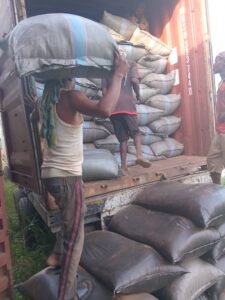
10. Packaging Options for Vietnam
Packaging depends on the buyer’s warehouse, handling system and shipping arrangement.
Possible options include:
PP Woven Bags
Suitable for buyers who prefer individually handled bags.
FIBC / Jumbo Bags
Suitable for buyers with forklifts or other mechanical handling equipment.
Bulk Container Loading
Bulk loading with a suitable container liner may be considered where the buyer has the right unloading and handling facilities.
Packaging should be agreed before the quotation is finalized because it can affect loading, handling and freight economics.
The quotation and commercial agreement should clearly state the agreed packaging arrangement.
11. How Much Cocoa Shell Can Be Loaded in a Container?
There is no single container quantity that applies to every cocoa-shell shipment.
The final quantity depends on:
- Product density
- Packaging
- Loading method
- Container type
- Applicable road and port weight restrictions
- Carrier requirements
- Actual loaded weight
For this reason, buyers should not assume that every 40ft container will carry exactly the same quantity.
The agreed quantity should be established before booking, while the actual loaded weight should be recorded during loading and reflected in the shipping documents.
For Enbri Nig. Ltd., the final shipment quantity is confirmed according to the agreed specification, packaging, loading arrangement and actual availability.
12. Choose the Right Shipping Term
A Vietnamese buyer may request FOB, CFR or CIF depending on how it wants the freight and insurance arranged.
The applicable Incoterms® rule should be clearly stated in the commercial agreement.
FOB Nigeria
Under FOB, the seller delivers the goods on board the vessel at the named port of shipment, with risk transferring when the goods are on board.
For containerized cargo delivered to a terminal before loading, the parties should consider whether FCA is more appropriate for the actual delivery arrangement.
CFR Vietnam
Under CFR, the seller arranges and pays for carriage to the named destination port, while risk transfers when the goods are delivered on board the vessel.
The seller is not required to purchase insurance for the buyer under CFR.
CIF Vietnam
Under CIF, the seller arranges carriage and insurance to the named destination port, subject to the requirements of the CIF rule.
The buyer should specify the named port and the applicable Incoterms® 2020 rule in the contract.
13. Do Not Compare FOB Prices Alone
A Vietnamese importer should compare the estimated landed cost, not only the supplier’s FOB price.
A simple commercial comparison may include:
Product price + ocean freight + insurance where applicable + destination charges + customs duties/taxes + customs clearance + local handling.
The actual calculation will depend on the transaction and applicable Vietnamese import requirements.
Two suppliers may offer different FOB prices but produce different delivered costs because of:
- Freight rates
- Packaging
- Container utilization
- Insurance
- Port charges
- Customs treatment
- Local handling
Compare quotations on the same commercial basis.
14. What Documents Should a Vietnamese Buyer Expect?
The document package depends on the transaction and destination requirements.
A shipment may involve:
- Commercial invoice
- Packing list
- Bill of lading
- Certificate of origin
- Phytosanitary certificate, where applicable
- Fumigation certificate, where applicable
- Certificate of Analysis, where required or agreed
- Inspection documentation, where agreed
- Other documents required by Vietnamese authorities
The buyer should provide its documentation requirements to the exporter before the shipment is prepared.
This gives both sides time to coordinate the necessary documents.
The final document list should be confirmed between the Vietnamese importer, its customs broker and the exporter before shipment.
15. Laboratory Testing and Independent Inspection
A buyer should distinguish between a general product description and testing of the actual shipment.
Depending on the application, testing may cover:
- Moisture
- Ash
- Calorific value
- Particle size
- Foreign matter
- Heavy metals
- Mycotoxins
- Other agreed parameters
The required testing should be stated in the commercial agreement.
Enbri Nig. Ltd. does not treat one historical laboratory result as automatically representing every future cocoa-shell shipment.
Where laboratory analysis or independent inspection is required, the testing arrangement can be agreed before shipment.
The important point is that the agreed test should relate to the specification of the transaction and, where required, the actual cargo being shipped.
16. How Should a Vietnamese Buyer Evaluate the Supplier?
Before committing to a substantial order, a buyer should verify the supplier and the transaction.
Useful checks include:
Company Identity
Confirm the supplier’s legal company name, registration information and contact details.
Product
Confirm exactly what material is being offered.
Origin
Confirm the declared country of origin.
Quantity
Establish the quantity available for the specific shipment and any future supply programme.
Specification
Compare the supplier’s specification with the buyer’s plant or processing requirements.
Packaging
Confirm the agreed bag type, FIBC arrangement or bulk-loading method.
Inspection
Agree whether inspection or laboratory testing is required.
Shipping
Confirm loading port, destination port, Incoterm and shipment period.
Documentation
Confirm the documents required for import clearance.
For a broader supplier-verification checklist, see our article 7 Things Every International Buyer Should Verify Before Choosing a Cocoa Shell Supplier.
17. What Should a Vietnamese Buyer Confirm Before the Contract?
Before signing a purchase agreement, both sides should have a written understanding of:
- Product description
- Quantity
- Origin
- Specification
- Packaging
- Loading arrangement
- Loading port
- Destination port
- Incoterm
- Price
- Payment terms
- Shipment period
- Inspection requirements
- Laboratory-testing requirements, if any
- Required export documents
- Required Vietnamese import documents
- Procedure for handling a quality dispute
This is safer than agreeing only on a price through informal messages.
The commercial contract should also make clear which party is responsible for costs, documents and procedures falling outside the seller’s obligations under the agreed Incoterm.
18. How the Import Process Can Work
A practical transaction can follow this sequence:
Step 1 — Buyer Defines the Requirement
The buyer provides:
- Quantity
- Application
- Specification
- Packaging
- Destination port
- Shipment period
- Preferred trade term
Step 2 — Supplier Reviews Availability
The supplier confirms whether the required material and quantity can be supplied.
Step 3 — Specification Is Agreed
Both parties agree on the product requirements before the commercial contract is finalized.
Step 4 — Vietnamese Import Requirements Are Checked
The buyer or its customs broker confirms the applicable classification, customs, plant-quarantine and documentation requirements.
Step 5 — Commercial Quotation
The supplier provides the quotation based on the agreed quantity, specification, packaging, destination and trade term.
Step 6 — Contract and Payment
The parties agree on the commercial terms and payment arrangement.
Step 7 — Cargo Preparation
The agreed material is prepared and packed according to the contract.
Step 8 — Inspection or Testing
Where required, the agreed inspection or laboratory testing is carried out.
Step 9 — Export Documentation
The required Nigerian export documents are prepared.
Step 10 — Container Loading and Shipment
The cargo is loaded, the actual weight is established, shipping documents are issued and the container is shipped.
Step 11 — Vietnam Import Clearance
The Vietnamese importer or its customs broker handles the required customs, quarantine and other destination procedures.
The sequence can vary depending on the transaction, product use and destination requirements.
19. Common Mistakes Buyers Should Avoid
Buying Only on Price
The lowest FOB price does not necessarily produce the lowest landed cost.
Failing to Specify the Application
A biomass plant and a fertilizer manufacturer may require different specifications.
Assuming a Generic Laboratory Report Represents Every Shipment
Testing should relate to the agreed specification and, where required, the actual cargo.
Waiting Until Arrival to Check Import Requirements
Vietnamese customs and plant-quarantine requirements should be checked before shipment.
Assuming Every Container Carries the Same Quantity
Actual loading depends on density, packaging and applicable weight restrictions.
Leaving the Incoterm Unclear
The quotation should state the applicable Incoterms® rule and named place or port.
Comparing Suppliers on Price Alone
The buyer should also consider specification, documentation, packaging, inspection, freight and overall landed cost.
20. Working With Enbri Nig. Ltd.
For Vietnamese buyers, Enbri Nig. Ltd. discusses Nigerian-origin cocoa-shell supply according to:
- Buyer requirement
- Available material
- Agreed specification
- Quantity
- Packaging
- Destination
- Shipment schedule
- Commercial terms
Our current commercial supply discussion for cocoa shells is approximately 75–150 MT per month, subject to availability, specification and confirmed orders.
This is a commercial supply range, not a guaranteed production capacity for every month.
Actual availability should be confirmed before a purchase order or contract is finalized.
For buyers specifically interested in Vietnam, see our Cocoa Shell Supplier Vietnam page.
21. What Information Should You Send When Requesting a Quote?
A Vietnamese buyer does not need to send a complicated enquiry.
A useful request can be:
Product: Cocoa shells
Origin: Nigeria
Quantity: 100 MT
Application: Biomass fuel
Packaging: FIBC / Jumbo bags
Destination: Vietnam — nominated port
Specification: Buyer’s required parameters
Trade term: CFR or CIF
Shipment: Required shipment period
If you already have a plant specification, attach it to the enquiry.
This allows the supplier to quote against an actual requirement rather than providing a generic price.
22. Questions Vietnamese Buyers Often Ask
Can I Import Cocoa Shells from Nigeria into Vietnam?
Nigerian-origin cocoa shells can be considered for import into Vietnam, but the Vietnamese importer should confirm the applicable customs, plant-quarantine and other destination requirements before shipment.
What Is the HS Code for Cocoa Shells in Vietnam?
The Vietnam Trade Information Portal lists HS 1802.00.00 for cocoa shells, husks, skins and other cocoa waste.
The importer should confirm the applicable classification with its customs broker before declaration.
Are Cocoa Shells Subject to Plant Quarantine?
The Vietnam Trade Information Portal provides a plant-quarantine framework for imports and identifies procedures for articles subject to plant quarantine.
The Vietnamese importer should confirm the specific requirements applicable to the product and shipment before ordering.
Do I Need a Phytosanitary Certificate?
A phytosanitary certificate may be required depending on the applicable import requirements.
On the Nigerian side, the Nigerian Export Promotion Council identifies phytosanitary certification through the Nigerian Agricultural Quarantine Service among the quality-assurance documents used for agricultural exports.
The Vietnamese importer should confirm whether the certificate is required for the specific shipment before the cargo is prepared.
Can Enbri Quote CFR or CIF Vietnam?
Commercial quotations can be discussed according to the quantity, packaging, destination port, shipment period and agreed specification.
How Much Cocoa Shell Can Enbri Supply?
Our current commercial supply discussion is approximately 75–150 MT per month, subject to availability, specification and confirmed orders.
Can I Request Laboratory Testing?
Yes. If testing is required, the parameters and testing arrangement can be agreed before shipment.
What Applications Are Supported?
Cocoa shells may be considered for biomass, pellet and briquette production, composting, agricultural applications, biochar and other industrial uses, subject to the buyer’s requirements.
Conclusion
Importing cocoa shells from Nigeria to Vietnam is not simply a matter of finding a supplier and booking a container.
A successful transaction starts with understanding the buyer’s application, agreeing the product specification, checking the applicable Vietnamese import and plant-quarantine requirements, and establishing the commercial terms before the cargo is prepared.
For Vietnamese buyers, particular attention should be given to:
- HS classification
- Plant-quarantine requirements
- Required import documentation
- Product specification
- Packaging
- Container loading
- Inspection or laboratory testing
- Incoterms
- Landed cost
- Shipment documentation
Vietnamese importers should check the Vietnam Trade Information Portal and the relevant Vietnamese plant-quarantine authorities for current requirements before shipment.
On the Nigerian side, export documentation should also be prepared according to the applicable requirements and the agreed transaction.
Enbri Nig. Ltd. discusses Nigerian-origin cocoa-shell supply according to buyer requirements, available material and agreed commercial terms.
If you are a Vietnamese importer, biomass company, fertilizer manufacturer, compost producer, biochar processor or commodity trader looking for Nigerian cocoa shells, send us:
Quantity + Application + Specification + Packaging + Destination Port + Shipment Period
We can then review the requirement and discuss the appropriate supply and shipping option.
Enbri Nig. Ltd.
Benin City, Edo State, Nigeria
Procurement: +2349137834286
Email: info@enbrinigltd.com.ng
Nigerian Cocoa Shell Supply for Vietnam — specification first, documentation clear, shipment arranged according to the agreed transaction.